Eisenstein and Sound Film
The 1927 Hollywood film “The Jazz Singer”, was the first major production that used sound.“Silent films“ were increasingly replaced by sound films – at the time colloquially known as “talkies”.The transition from silent to sound film marked a major shift in film practice and theory. For some film makers the introduction of sound created an opportunity they had been waiting for – to record actors and their dialogues in a naturalistic style. Others – including Eisenstein – saw sync sound as a threat. They feared that focusing on dialogue would eliminate previous achievements of cinematography – especially the use of montage – and turn films into “filmed theatre”. While working in theatre, Eisenstein had already been experimenting with sound. He arranged sounds musically in rhythmic sequences. He was especially intrested in polyphony.
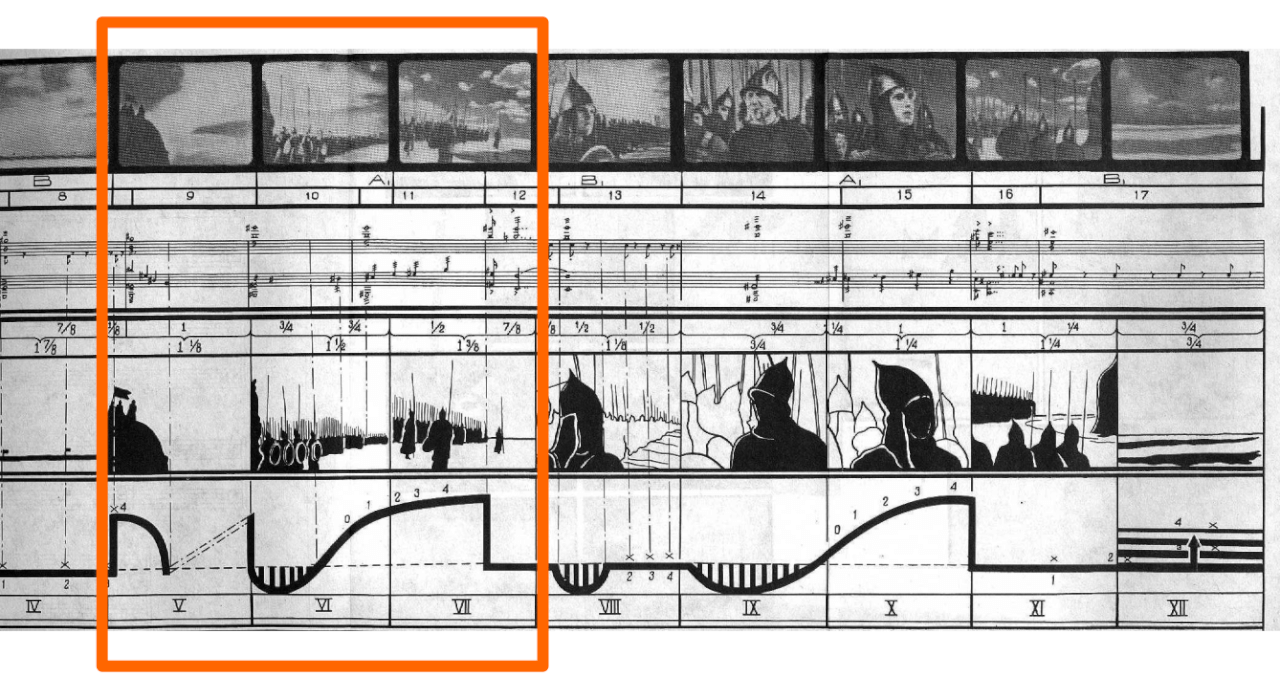
In his famous 1928 manifesto on sound film, Eisenstein, together with Pudovkin and Alexandrov, argues for the asynchronous use of sound. He introduces the musical concept of the counterpoint. Sound should not simply duplicate the image’s meaning. Instead it should add a new connotation to it – creating a third level of associations.
Working with Synthetic Music – The Theremin
In his films Eisenstein experimented with sound. In his first sound film, “Romance Sentimentale”, he applied at technique used also by other contemporary Soviet artists. He drew shapes onto the optical sound track. This created strange screeching sounds. He combined them with noises and fragmented orchestral recordings. This assembly created a counterpoint to the sentimental opening sequence of the film. In the auditive concept for his film “The General Line”, he developed a system of different types of sound. He wanted to combine them in an experimental way. In addition to symphonic and folkloric music and a combination of noises and drawn sounds, he also wanted to use electronic music Eisenstein’s idea to use synthetic music was inspired by an invention made by his contemporary Lev Theremin. He had created the world’s first electronic instrument – the Theremin. For Eisenstein the Theremin symbolized the “sound of the future”. Eisenstein was unable to find partners in order to realize his sound concept for “The General Line”. We can only guess how he would have implemented the ideas described in his concept. It is likely that Eisenstein wanted to use the Theremin in those parts of the film that are related to the idea of social utopia. One of them is a sequence where the main character, Marfa, dreams of a better future.

Our Web Theremin Application
Eisenstein’s love of experiments and his idea of sound montage inspired our sound research. Most probably, Eisenstein meant to use the Theremin for a scene in the end of “The General Line”.
We have developed a Web Theremin. It is implemented as a hybrid application for the web. Playing it you will be able to accompany this scene. It is a first prototype for our virtual Theremin.
